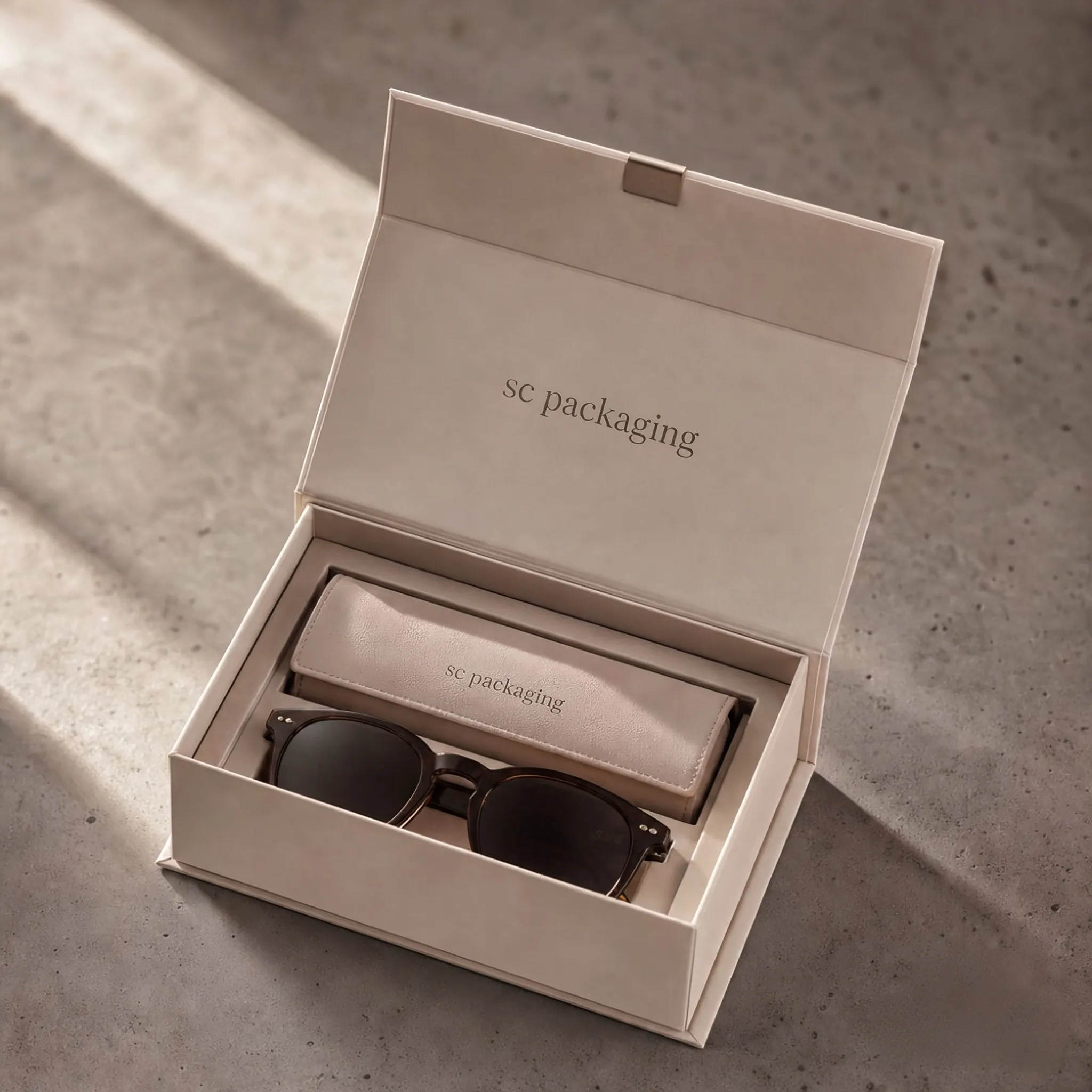


Our team of specialists will provide you with a personalised, one-to-one service, ensuring that your partnership with SC Packaging is hassle-free and gives you complete peace of mind.
Custom Eyeglass Packaging Boxes: How to Specify the Right Box Before You Order
The most common packaging mistake is choosing a box style before confirming what has to fit inside it.
A folded frame by itself has one footprint. The same frame inside a hard case, with a cleaning cloth and warranty card, needs a different box. If the package is sized from the lens width alone, the folded temples or case may interfere with the insert or lid. If the cavity is too loose, the frame can move and rub against the packaging.
For custom eyeglass packaging boxes, start with the complete pack-out: every item the customer will receive, arranged as it will be packed. Then choose the box around the product, sales channel and shipping route.
A retail box, a hard glasses case and a shipping carton do different jobs. Combining them into one oversized box can add material and freight cost without improving the customer experience.
This decision determines whether you need a simple folding carton, a fitted presentation box, a separate mailer—or more than one of these.
| Pack-out and channel | A practical starting point | Why |
|---|---|---|
| Frame in a hard case, sold at an optical counter | Folding carton or sleeve fitted to the case | Keeps the retail package compact when the hard case does the everyday protection. |
| Single-pair DTC order | Fitted product box inside an appropriately sized shipping carton | Separates the presentation job from the parcel-protection job. |
| Premium gift or launch set | Rigid box with a fitted insert | Accommodates a higher-touch presentation and keeps accessories arranged. |
| Multi-item or promotional kit | Box with divided insert or planned accessory layout | Prevents the frame, cloth and printed materials from shifting into one another. |
A rigid box gives a substantial feel, but it is larger and heavier than a folding carton. That can affect storage, packing and shipping. A corrugated mailer is useful as the outer shipping layer, but it does not automatically solve the fit inside the retail package. Choose each component for the job it performs.
Send the packaging supplier the folded frame dimensions and the dimensions of every included item. If there is a hard case, measure the case—not just the glasses. Confirm which item sits highest when the package is closed; that is often what determines the box depth.
The insert should hold the product at stable points without putting pressure on the lenses or making the frame difficult to remove. The temples, bridge and case shape may all affect where support is needed. Keep enough clearance to avoid rubbing, but not so much that the product slides around.
Insert material should follow the job:
These are starting points, not interchangeable specifications. The right choice depends on the product geometry, box structure, quantity and packing process.
A low unit price can be offset by an oversized box, a heavy rigid structure, a complex insert or additional packing time. For ecommerce, the outer carton and freight volume also matter.
When comparing quotations, ask suppliers to show the main cost components separately where possible: box, insert, special finishes, tooling or sampling, assembly, master carton and freight. If you are ordering at scale, request pricing at relevant quantity breaks. That makes it easier to compare a simpler structure against a premium option using the cost of the complete pack-out.
A flat artwork proof confirms the printed design; it does not confirm the fit. Before approving production, pack a physical sample using the actual frame, case and accessories.
Check that:
For direct-to-consumer orders, evaluate the assembled product package inside its shipping carton. If the box will travel through parcel networks, test the complete packed configuration—not the empty box by itself.
A supplier can give a more useful recommendation when the brief includes:
Ask the supplier to recommend a primary structure and explain the trade-off against one simpler or lower-cost option. The answer should address fit, insert, shipping configuration and packing—not only printing and logo placement.
Need a quote for custom eyeglass packaging boxes? Send the folded frame dimensions, full pack-out, sales channel and order quantity. Those details are the starting point for SC Packaging to choose a box that fits the product and the way you sell it.
From eco-friendly paper stocks to luxury foil stamping and spot UV finishes, we deliver flawless custom packaging tailored to your brand identity.
Welcome to SC Packaging
Get more help directly
 Optimized by Seraphinite Accelerator